
























Petrified Forest National Park is an amazing natural resource located in northeast Arizona. Take the time to look throught the orientation page to get a better idea of the layout of the land and to learn of the different points of interests within the park.
Overview
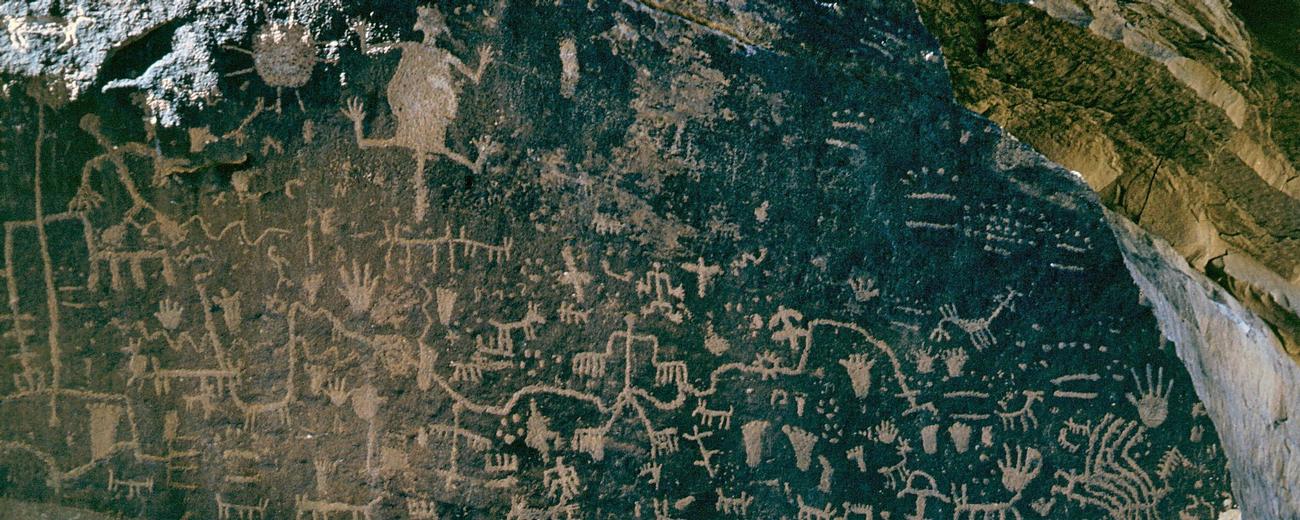
Petrified Forest is a surprising land of scenic wonders and fascinating science. The park is located in northeast Arizona and features one of the world's largest and most colorful concentrations of petrified wood. Also included in the park's 93,533 acres are the multi-hued badlands of the Painted Desert, archeological sites and displays of 225 million year old fossils.
Park activities include the park film, museums, sightseeing, photography, walking, hiking and wilderness backpacking. A variety of ranger programs are given year round with an increased number during the summer. A program schedule is displayed at visitor contact areas.
Note: The removal of petrified wood or other features of the park is prohibited by law. Gift shops sell petrified wood that comes from private land, outside the park. No petrified wood is removed legally from the park.
Driving non-stop through the park takes 45 minutes. The average length of stay is 2 hours but remaining all day is also common. The park is locked at night and visitors must be in their cars and driving towards an exit at closing time.
Petrified Forest National Park is open at different hours during the year:
Chinde Gate and the South Entrance Gate:
Jan 1 to Feb 25 - 8 am to 5 pm
Feb 26 to May 5 - 7 am to 6 pm
May 6 to Sept 3 - 7 am to 7 pm
Sept 4 to Oct 20 - 7 am to 6 pm
Oct 21 to Dec 31 - 8 am to 5 pm
North Entrance Gate:
Jan 1 to Feb 25 - 8 am to 5 pm
Feb 26 to Apr 7 - 7 am to 7 pm
Apr 8 to Sept 3 - 7 am to 8 pm
Sept 4 to Oct 20 - 7 am to 7 pm
Oct 21 to Dec 31 - 8 am to 5 pm
Points of Interest
Painted Desert
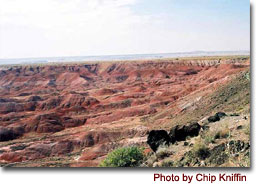 A 27 mile road runs through the Park, from I-40 exit 311 to US 180; the closest town is Holbrook, 25 miles to the west. The visitor center is at the north end and there is a small museum at the south entrance.
Eight overlooks along the rim give sweeping views of portions of the Painted Desert. Also, the Painted Desert Rim Trail is an easy, unpaved 1.2-mile round trip that winds along the Painted Desert rim between Tawa and Kachina Points. The vivid colors of the desert are especially striking at sunset.
The Painted Desert Inn Museum at Kachina Point was built in the 1920's and was rebuilt by Civilian Conservation Corps in the late 1930's. In 1987, it was designated as a National Historic Landmark. Access to the Painted Desert Wilderness is behind the inn; wilderness camping begins beyond the washes.
Blue Mesa
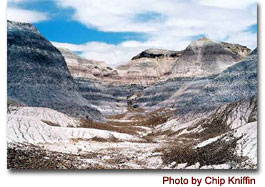 Blue Mesa is reached by a short loop road, and has many logs lying around an area of undulating blue-grey mounds of clay. Often the logs lie partially buried in the clay, and erosion gradually but continuously exposes more of them. There is no backcountry hiking in this region, as the ground is covered with a very delicate, crust-like plant life, and even a footprint can cause destruction that will take years to grow back.
The best way to see the area is via the Blue Mesa Trail, a 1 mile steep, paved loop that leads from the top of the mesa down into the blue badlands, a colorful area of cone-shaped hills in Chinle Shale.
Jasper Forest
The Jasper Forest overlook shows the area's topography, with petrified logs strewn below. Logs with root systems show that some of the trees grew nearby.
Crystal Forest
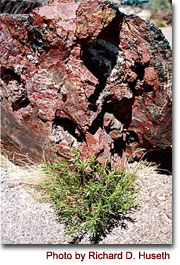 Further south, the Crystal Forest Trail leads through the trees of Crystal Forest.
This area was once strewn with especially beautiful logs, which had crevices containing clear quartz and purple amethyst crystals, but all the best specimens were removed by souvenir hunters long ago.
It was this theft that prompted local citizens to petition for the creation of the then National Monument, which was established in 1906 - National Park status was not achieved until 1962. A few small crystalline specimens can still be seen, amongst other more typical logs.
Rainbow Forest
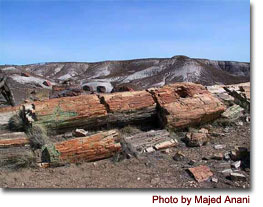 The area with the most densely-scattered petrified wood is Rainbow Forest, near the south park entrance. There is a museum, which amongst other exhibits has a large collection of apologetic letters sent by visitors who have taken rock samples and later regretted their actions. Hundreds of pieces of petrified wood are returned each year.
Through the museum, a short foot trail winds through the Giant Forest area which has some of the biggest logs in the park. Nearby, the Long Logs Trail gives perhaps the most impressive views - the path passes hundreds of large beautifully coloured examples, often several metres in length. There is also the Agate House Trail, which leads to a partially restored pueblo constructed entirely of petrified wood by Indians in the 16th century.
Some Other Things To Know
Pets
Pets are permitted on maintained trails and must be kept on a leash. Pets are not allowed in buildings, unless they are service animals. Please clean up after your animals.